
Personal Information
- (Professor)
Gender:
MaleDiscipline:
Acoustics. Optics. Condensed Matter PhysicsEducation Level:
With Certificate of Graduation for Doctorate StudyDiscipline:
1 Acoustics;
1 Optics;
1 Condensed Matter Physics
Other Contact Information
-
ZipCode
7babf8b996fc02ba8f391f8b71b22a8bcd3f4abeccc50782ac500df2fc7bbbfd33ec0121535ccb720ea6e8c8df3da800745dcf948c0bd9a02ad5c77e04e6d33c04185bb88739ad1e39fd79615c8afd8e3118d468533fff05fefb4c3e65073aa021f4b7573ae694db00bd0033171d46e65f649f546418a26ce92eabcfbdf7fea1 -
PostalAddress
14da4b058cc6c8fd9f13c292347ca8926a9d7a11783f5f48e0e675dcb4a46ffbbf8038bd204689e46ed015cea133adf35509ba76687d7097671d38a9bc6460eaf0bf5f97600be544abd4f6ad8a690711eaa16a5ee79aa2055b67989adfbe6504a5046edb34dcfdf53713a19edb57267993e0bd67a214d6f2f4f2e1cde417a1b3 -
email
07a6a8f1600fc9f509bb97322af381894a7656bb803f70f1eee67af3f98a92ec2aede598b4d92c576f414b94557f2a6c36315a9e3d6bc4c44d7ebc64bda2a6d40d83981c2d70810d16711ce1454bdbaae8a3b0b4780ccfc2a2bc7ebfc38410c10c301058ca0d4af6c737b901fb83dca4aa9aa509da4e4afe72ca660b8019bae4


Fully Flat Bands in a Dipolar Kagome Lattice
Overview:
Recently, the team led by Professor Meng Xiao at Wuhan University, in collaboration with the group of Associate Professor Zhen Gao at Southern University of Science and Technology, proposed and verified a brand-new mechanism for realizing flat bands. By simply rotating the orientation of dipoles in a p-orbital Kagome lattice, band inversion can be induced at specific critical angles, resulting in perfectly flat bands with triple degeneracy across the entire Brillouin zone. Unlike traditional schemes that rely on a single flat band in s-orbital Kagome lattices, this mechanism can “flatten” the entire band structure simultaneously, completely eliminating dispersive modes and achieving compatibility with arbitrary excitation sources. This scheme does not rely on specific lattice symmetries and therefore possesses good universality and scalability, making it applicable to various lattice types and higher-order optical modes. Based on a photonic crystal experimental platform, the research team successfully observed the theoretically predicted flat-band dispersion and field localization effects, verifying the feasibility of this mechanism in real systems. This work provides a new and easily tunable physical pathway for flat-band engineering and has potential applications in compact photonic devices and high-efficiency information processing. The related results were published in Physical Review Letters under the title “Fully Flat Bands in a Photonic Dipolar Kagome Lattice”, and were selected as an Editors’ Suggestion. PhD student Hanrong Xia from Wuhan University (currently a postdoctoral researcher at Southern University of Science and Technology) is the first author of the paper. Professor Meng Xiao from Wuhan University and Associate Professor Zhen Gao from Southern University of Science and Technology are the co-corresponding authors. PhD student Ziyao Wang from Southern University of Science and Technology and undergraduate Yunrui Wang from Wuhan University (currently a PhD student at the University of Texas at Austin) also made important contributions to this work.
Research Background:
Flat bands are characterized by zero group velocity and strong energy localization, which can enhance interaction effects in both quantum and classical systems. Current approaches to realizing flat bands include mechanisms such as external magnetic fields, synthetic gauge fields, mode-coupling engineering, twisted structures, and Floquet modulation. Among them, methods based on lattice geometry and symmetry design (such as Lieb and Kagome lattices) are particularly convenient in two-dimensional photonic systems. However, in such systems the flat bands often become degenerate with dispersive bands at high-symmetry points, making selective excitation of flat bands difficult. Moreover, unavoidable long-range and higher-order couplings in real systems can destroy the flatness of the bands. To address these issues, inspired by geometrical frustration, this study constructs a p-orbital Kagome lattice with tunable dipole orientation in a photonic crystal and proposes and experimentally verifies a new mechanism for flat-band generation. We realize three completely flat and clean bands. This configuration exhibits robust localized field distributions under arbitrary excitation, allows band inversion controlled by dipole rotation, and shows robustness against long-range coupling, providing a simple and universal route for flat-band manipulation.
Research Highlights:
The research team considered a Kagome lattice unit cell consisting of three dipoles, and simultaneously rotated the three dipoles (Fig. 1a). Through tight-binding calculations, the band structures at different rotation angles were obtained. The calculated results for three representative angles are shown in Fig. 1b. In the initial unit cell configuration, the three bands consist of a conical dispersion (Dirac cone) and an intrinsic flat band above it. At 90°, the intrinsic flat band flips to the bottom of the conical dispersion. At 49.8°, all three bands become completely flat. Because rotating the dipoles changes the sign of the dipole–dipole interaction, the interaction between sites can vanish at certain critical angles. Analytical solutions show that for the Kagome lattice there exist two critical angles, 49.8° and 130.2°, within the interval from 0° to 180°. Figure 1c shows the variation of the total bandwidth W of the three bands with rotation angle.
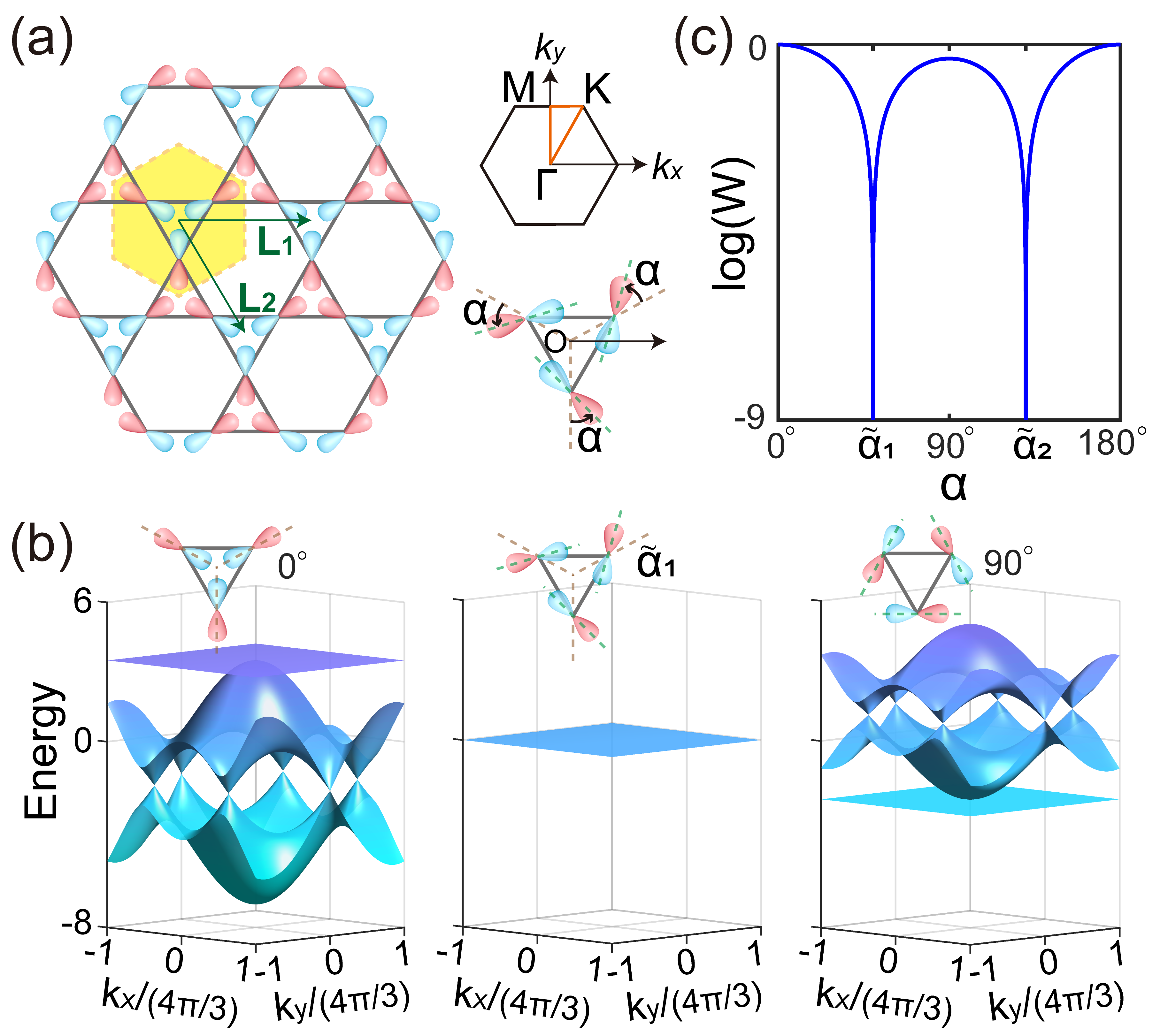
Figure 1 | Tight-binding calculations of the dipolar Kagome lattice.a. Schematic diagram of the lattice structure. The three p orbitals rotate simultaneously by an angle α.
b. Band structures at α=0∘, 49.8∘, and 90∘.c. The total bandwidth WWW of the three bands as a function of the rotation angle α.
The existence of flat bands implies the presence of localized excitation states in the system. However, for conventional s-orbital Kagome lattices, this only occurs for specifically designed source distribution patterns. In such cases, the field distribution can precisely reproduce the spatial configuration of the source, allowing deterministic excitation of the system through customized source patterns. To quantify the localization of the excitation field, we define a parameter P based on the overlap integral between the excitation field distribution and the excitation source function. Figure 2(b) shows the variation of P with the rotation angle α (from 0° to 180°). When the system reaches the two critical rotation angles, all three bands exhibit flat-band characteristics and P reaches its maximum value of 1. When the rotation angle deviates from these critical values, P decreases accordingly.
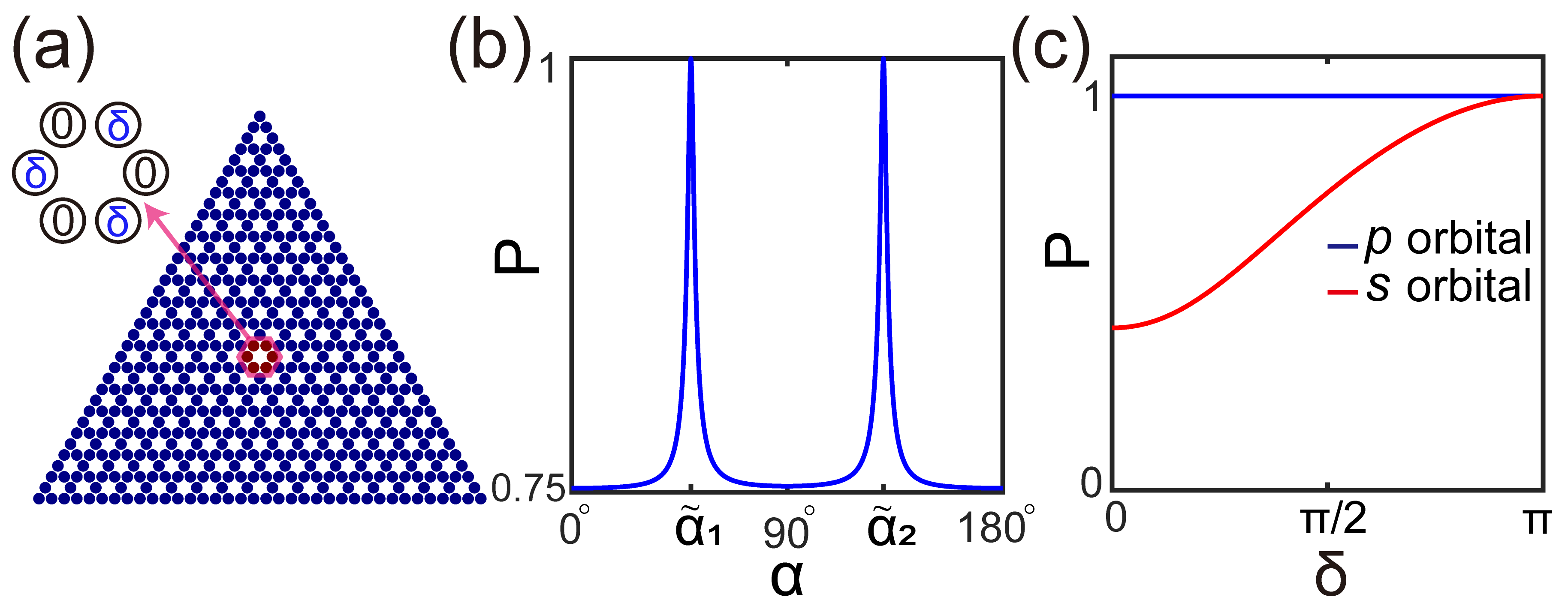
Figure 2 | Localized excitation under arbitrary sources.a. Schematic diagram of the excitation source configuration, consisting of six sites with equal amplitudes but a phase difference δ between neighboring sites.b. The localization degree of the excitation field as a function of the rotation angle.c. The localization degree of the excitation field as a function of the source phase parameter δ for p-orbital and s-orbital cases.
Next, we implemented the dipolar Kagome lattice in a photonic crystal platform. The unit-cell structure is shown in Fig. 3(a), where the degree of freedom α can be tuned by physically rotating dielectric rods. Figures 3(b)–3(d) show the eigenfield distributions of typical dipolar modes and higher-order modes. As shown in Figs. 3(e)–3(g), the photonic band structure can be divided into several three-band groups, among which three target groups are highlighted with different colored shading. The region below the red shading corresponds to s-like modes, which are not suitable for the aforementioned theory. The first two groups (red and green shading) correspond to dipolar modes, while the third group (blue shading) corresponds to higher-order modes. As α increases from 0° to 90° (with the situation from **90° to 180° being symmetric), the original flat band flips from the top to the bottom within the first two band groups. For the higher-order mode group, the bandwidth also varies with the rotation angle. In contrast, the s-like modes show no obvious bandwidth reduction. Figure 3(h) further shows the variation of the global bandwidth W for each band group within α ∈ [0°, 90°], with the minimum appearing around 60°.
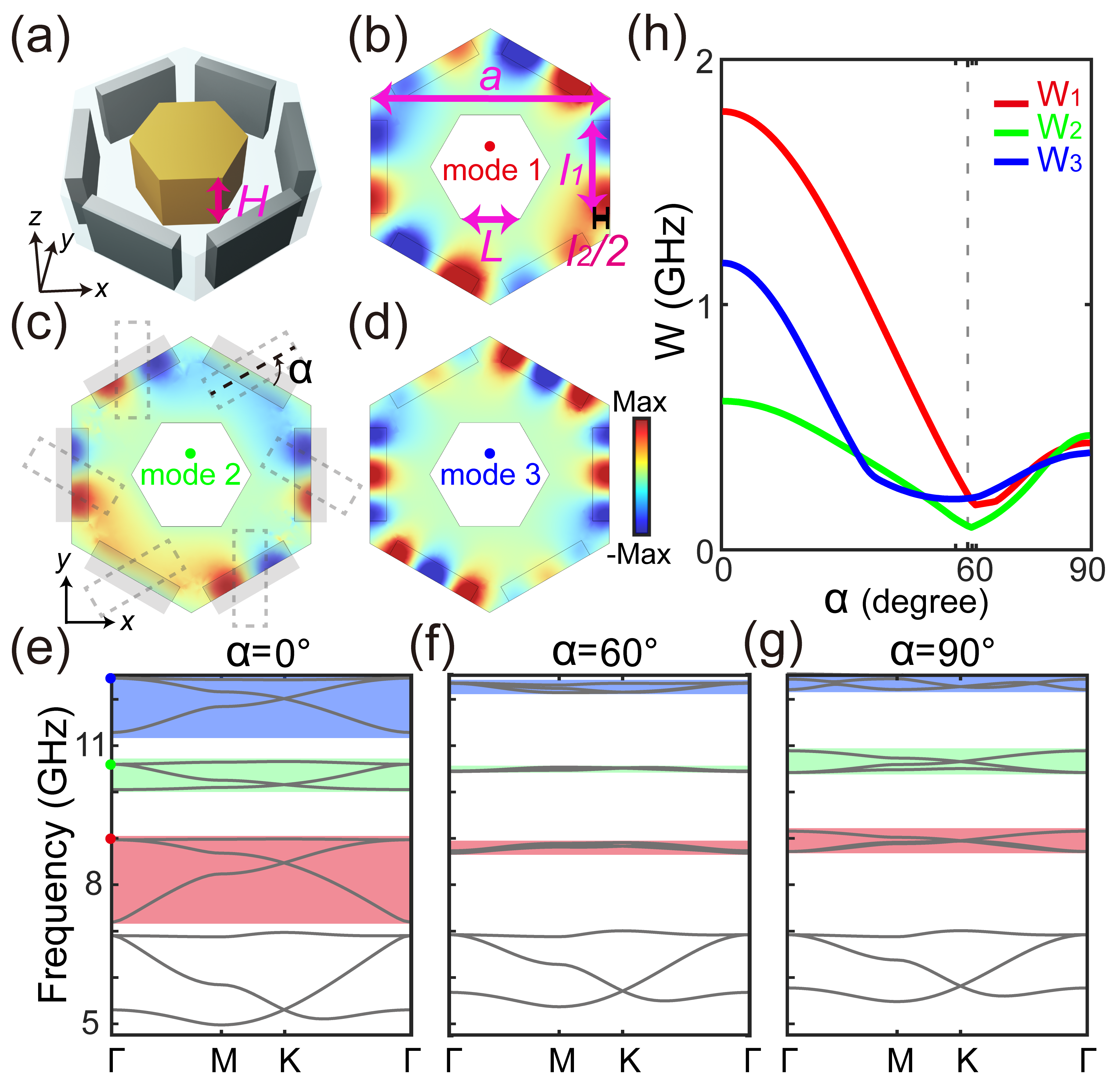
Figure 3 | Realization of the dipolar Kagome lattice in a photonic crystal.a. Schematic diagram of the unit cell when the rotation angle is 0°.b–d. Typical modal distributions of the three band groups (taking α = 0° as an example). The first two correspond to dipolar modes, and the third corresponds to a higher-order mode.e–g. Band structures at three representative rotation angles: 0°, 60°, and 90°.h. The variation of the global bandwidth W of each band group, whose minimum occurs near 60°.
To experimentally observe the photonic flat bands, we fabricated three samples with rotation angles α = 0°, 60°, and 90° [Figs. 4(a)–4(c)]. The insets at the bottom-right corners show magnified views of the corresponding unit cells. To clearly display the internal structure of the two-dimensional photonic crystal, the top metal plate was removed in the photographs. By exciting the photonic crystal and measuring the Ez field distribution, the spatial amplitude and phase distributions were Fourier transformed to obtain the band structure in momentum space [Figs. 4(d)–4(f)]. At α = 0° and 90°, the flat band lies above and below the Dirac cone, respectively. At α = 60°, the three bands exhibit relatively flat characteristics around 8.8 GHz and 10.5 GHz. To verify the field localization property at the flat-band frequency, we used a single-point current source for excitation and measured the Ez field distribution at 10.55 GHz under different rotation angles. The results show that when α = 60°, the field energy is localized near the source, whereas at other rotation angles it spreads throughout the lattice.
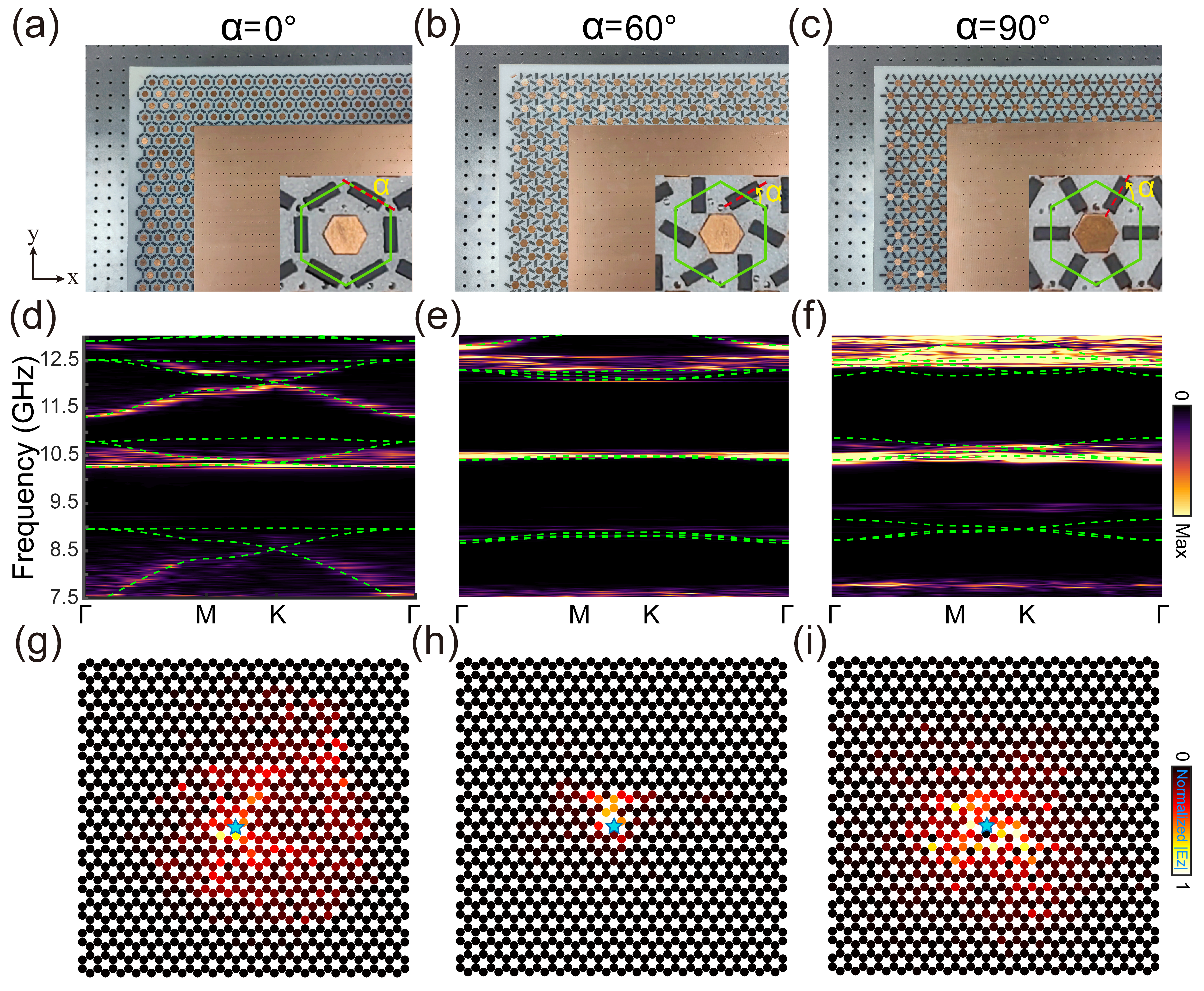
Figure 4 | Experimental observation of photonic flat bands.a–c. Fabricated samples corresponding to rotation angles α = 0°, 60°, and 90°.d–f. Comparison between measured and simulated band structures of the two-dimensional photonic crystal at different rotation angles.g–i. Measured electric field distributions of the three samples at 10.55 GHz.
Summary and Outlook:
From both theoretical prediction and experimental verification, the research team proposed a new mechanism for realizing multiple degenerate flat bands using p orbitals and rotational degrees of freedom. Compared with Lieb lattices and s-orbital Kagome lattices, the flat bands realized in this work are more robust against next-nearest-neighbor coupling and can be selectively excited without carefully designed source distributions. More importantly, this scheme does not rely on specific lattice geometries or symmetries and can be readily extended to other modes or lattice systems. This work provides a universal platform for flat-band design and opens new avenues for controlling wave localization and interactions in photonic, electronic, and mechanical systems.
Full article link:
https://journals.aps.org/prl/abstract/10.1103/bt9s-qsfj