
Personal Information
- (Professor)
Gender:
MaleDiscipline:
Acoustics. Optics. Condensed Matter PhysicsEducation Level:
With Certificate of Graduation for Doctorate StudyDiscipline:
1 Acoustics;
1 Optics;
1 Condensed Matter Physics
Other Contact Information
-
ZipCode
7babf8b996fc02ba8f391f8b71b22a8bcd3f4abeccc50782ac500df2fc7bbbfd33ec0121535ccb720ea6e8c8df3da800745dcf948c0bd9a02ad5c77e04e6d33c04185bb88739ad1e39fd79615c8afd8e3118d468533fff05fefb4c3e65073aa021f4b7573ae694db00bd0033171d46e65f649f546418a26ce92eabcfbdf7fea1 -
PostalAddress
14da4b058cc6c8fd9f13c292347ca8926a9d7a11783f5f48e0e675dcb4a46ffbbf8038bd204689e46ed015cea133adf35509ba76687d7097671d38a9bc6460eaf0bf5f97600be544abd4f6ad8a690711eaa16a5ee79aa2055b67989adfbe6504a5046edb34dcfdf53713a19edb57267993e0bd67a214d6f2f4f2e1cde417a1b3 -
email
07a6a8f1600fc9f509bb97322af381894a7656bb803f70f1eee67af3f98a92ec2aede598b4d92c576f414b94557f2a6c36315a9e3d6bc4c44d7ebc64bda2a6d40d83981c2d70810d16711ce1454bdbaae8a3b0b4780ccfc2a2bc7ebfc38410c10c301058ca0d4af6c737b901fb83dca4aa9aa509da4e4afe72ca660b8019bae4


Nanjing University and Wuhan University Teams Realize Thermal Emission Vortices Based on Bound States in the Continuum
Introduction
Optical vortices, such as phase vortices and polarization vortices, have been widely applied in many fields since their discovery. Over the past decades, numerous methods have been proposed to generate optical vortices. Among them, bound states in the continuum (BICs) featuring polarization vortices have been used to realize vortex lasers and vortex beams. However, polarization vortices have not yet been realized in thermal emission.
Recently, the research team from the School of Physics at Nanjing University collaborated with the research team from the School of Physics at Wuhan University and realized a polarization-vortex thermal emitter based on BICs in a photonic crystal slab. This work breaks through the material limitations of thermal emitters and enables arbitrary linear-polarization thermal emission within a single device, opening a new direction for thermal radiation control. The results were published in Science Advances on September 19, 2025, entitled “Polarization vortices of thermal emission” [Sci. Adv. 11, eadx6252 (2025)].
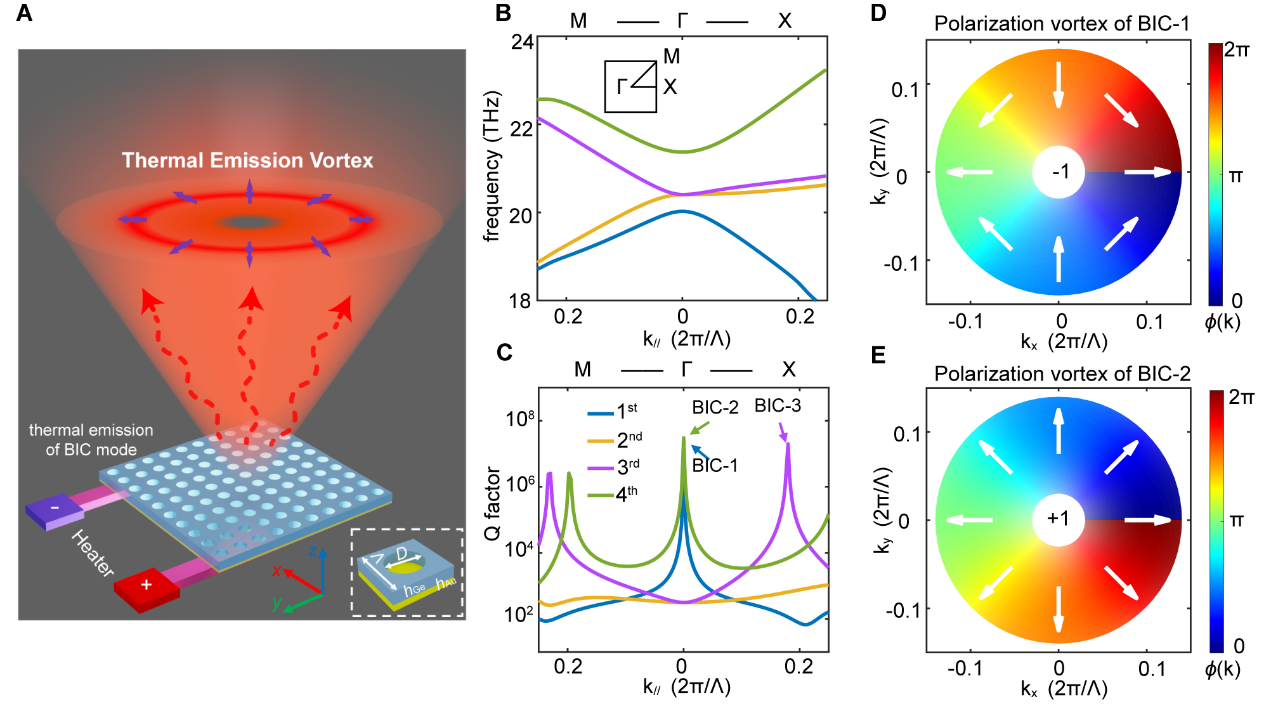
Figure 1(A) Schematic illustration of realizing polarization vortices of thermal emission in a photonic crystal slab.(B–C) Band structures of the photonic crystal slab along the Γ–X and Γ–M directions and the corresponding Q-factor distributions. The BICs are indicated by arrows.(D–E) Polarization vortices of BIC-1 and BIC-2 in momentum space, with characteristic topological charges of −1 and +1, respectively. The color represents the angle of the linear polarization direction relative to the horizontal axis, and the specific polarization vectors are indicated by white arrows.
Relevant Background Knowledge
Thermal radiation is electromagnetic radiation emitted by all objects with temperatures above absolute zero. Its control technologies have important applications in radiative cooling, infrared sensing, and energy harvesting. In recent years, researchers have achieved multidimensional control of thermal radiation, including wavelength selection, directional control, and polarization regulation [1–2].
However, existing studies still face two challenges. First, the polarization states of thermal radiation generated by a single emitter are limited. Since such emitters typically rely on localized resonance modes, a single structure can only radiate a few polarization states. To obtain multiple polarization states, different structures must be designed and fabricated. Second, as an important part of singular optics, polarization vortices possess unique and flexible polarization control capabilities. Utilizing thermal radiation polarization vortices can produce continuous polarization thermal radiation fields, yet such polarization vortices have not been realized in thermal emission so far.
Structure Design & Theoretical Calculation
Based on a photonic crystal slab, the research team designed the thermal emitter shown in Fig. 1(A) to realize polarization vortices in the far field. The structure is mainly formed by etching periodically distributed circular air holes in a germanium thin film, creating a two-dimensional photonic crystal slab with in-plane C4 symmetry. A metallic film beneath the photonic crystal slab effectively suppresses the thermal radiation signal from the substrate, ensuring that the radiation signal originates from the guided resonance modes of the photonic crystal slab.
Because the photonic crystal slab possesses C4 symmetry, it supports symmetry-protected bound states in the continuum (BICs), such as BIC-1 and BIC-2 located at the Γ point (Fig. 1(B–C)). In addition, the structure also supports accidental BICs protected by asymmetry, such as BIC-3 located along the Γ-X line. As shown in Fig. 1(D–E), constrained by topological properties, different BICs exhibit different polarization vortex distributions. The topological charge of BIC-1 is −1, and its polarization direction, indicated by white arrows, changes by −2π along a circular path in momentum space. The topological charge of BIC-2 is +1, with polarization aligned along the radial direction, changing by +2π along a circular path in momentum space.
Polarization–Angle-Resolved Thermal Emission Measurement
The team independently constructed the polarized angle-resolved thermal emission measurement system shown in Fig. 1(A), namely the Polarized Angle-resolved Thermal Emission Spectrometer (PARTES), which enables observation of polarization states in momentum space. Using ultraviolet lithography and electron-beam evaporation techniques, researchers fabricated photonic crystal slabs at the micrometer scale. The SEM image in Fig. 2(B) shows details of the photonic crystal slab, with an overall sample size of 2 cm × 2 cm.
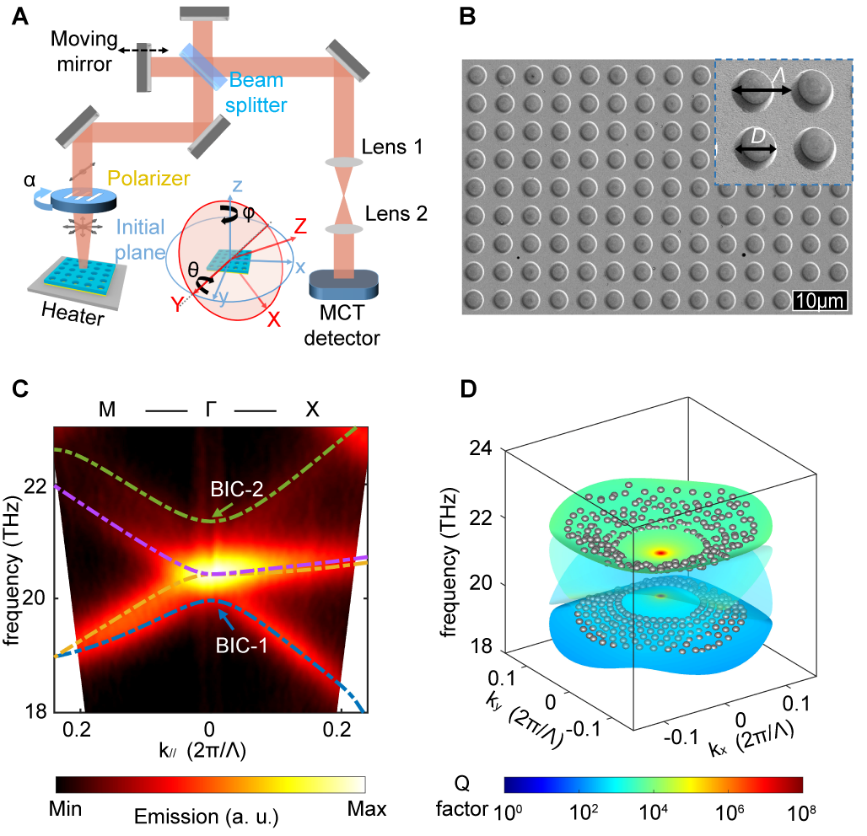
Figure 2 (A) Schematic illustration of the polarized angle-resolved thermal emission measurement system (PARTES).(B) SEM image of the experimental sample.(C–D) Angle-resolved thermal emission measurements of the sample and the corresponding dispersion surfaces in momentum space.
Figure 2(C) presents the measured thermal emission spectra along two high-symmetry directions. The radiation signal in the black region is extremely weak, while the bright region corresponds to guided resonance modes of the photonic crystal slab radiating into the far field, consistent with theoretical simulations (dashed lines). Since BIC-1 and BIC-2 are confined within the photonic crystal slab, they cannot be directly observed in the far field, resulting in weak intensity. By scanning the radiation angles (θ, φ), the thermal emission signals of guided resonance modes can be extracted in momentum space (marked as gray dots in Fig. 1(D)), which match well with the theoretically calculated dispersion surfaces (colored surfaces in Fig. 1(D)). Furthermore, by inserting a linear polarizer in the optical path, polarization–angle-resolved thermal emission measurements of the photonic crystal slab can be achieved.
Thermal Emission Polarization Vortices of Symmetry-Protected BICs
By adjusting the transmission direction α of the linear polarizer, the polarization states around the BICs can be accurately measured. As shown in Fig. 3(A–B), along the radiation azimuth φ = 0° (Γ-X direction), the thermal radiation signals around BIC-1 and BIC-2 are strongest when the polarizer is oriented at α = 0° and weakest at α = 90°, indicating that the polarization state is parallel to the wave vector direction. Along the radiation azimuth φ = 45° (Γ-M direction), the thermal radiation signal around BIC-1 is strongest when α = 90° and weakest when α = 0°, indicating that its polarization state is perpendicular to the wave vector direction. In contrast, the polarization state around BIC-2 remains parallel to the wave vector direction.
By scanning along a circular path surrounding the BIC point, as shown in Fig. 2(D), the researchers measured the polarization vortex evolution associated with BIC-1 and BIC-2. As shown in Fig. 3(C–D), the blue solid line represents the calculated polarization angle variation along the path, the orange dots represent experimental measurement points, and the yellow bars represent error bars. The experimental results agree well with theoretical predictions: the polarization variation of BIC-1 is −2π, while that of BIC-2 is +2π. In addition to symmetry-protected BICs, the researchers also measured the polarization vortex associated with the accidental BIC-3. This method can be extended to other BICs, enabling the generation of multiple thermal emission polarization vortices on a single sample.
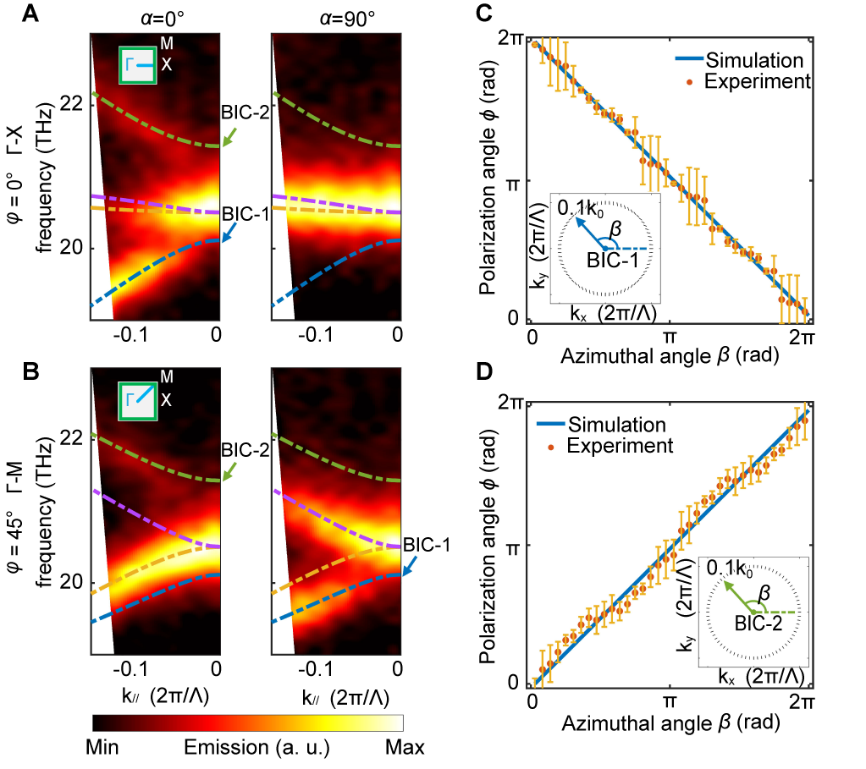
Figure 3 (A–B) Thermal emission spectra measured along the directions φ = 0° and φ = 45° with two different polarizer orientations (α = 0° and α = 90°). (C–D) Polarization angles measured along the azimuthal path surrounding the BICs; the points with error bars represent experimental data, and the solid lines represent simulation results. The insets show the paths of the polarization vortices.
Summary and Outlook
The research team realized polarization vortices in thermal emission based on bound states in the continuum in photonic crystal slabs, providing a flexible, scalable, and fabrication-friendly approach for controlling the polarization of thermal radiation. By utilizing polarization vortices surrounding BICs in momentum space, researchers can generate arbitrary linear polarization states of thermal radiation from a single device. The team also successfully observed polarization vortices of thermal emission using their self-developed polarized angle-resolved thermal emission spectroscopy system (PARTES).
This research enables broadband frequency and polarization control without requiring an external infrared light source, providing a directly integrable technological foundation for applications such as miniaturized thermal imaging, infrared sensing, and on-chip information encryption, and opening new perspectives for the design of advanced thermal emitters.
Acknowledgements
Dr. Ye Zhang (Nanjing University) and Associate Professor Qiang Wang (School of Physics, Nanjing University) are co-first authors of the paper. Professor Hui Liu and Associate Professor Qiang Wang from Nanjing University, together with Professor Meng Xiao from Wuhan University, are the co-corresponding authors. This work was carried out under the guidance of Professor Shining Zhu.
This research was supported by the State Key Laboratory of Solid State Microstructures, the Jiangsu Center for Physical Science Research, and the Collaborative Innovation Center of Advanced Microstructures, as well as funding from the National Natural Science Foundation of China, the National Key Research and Development Program of China, and the Natural Science Foundation of Jiangsu Province.
Related References
[1] Controlling thermal emission with metasurfaces and its applications (Review Paper), Nanophotonics 13, 1279 (2024)
[2] Thermal radiation control based on metasurfaces and infrared applications (Review), Acta Optica Sinica 44, 1925001 (2004)